
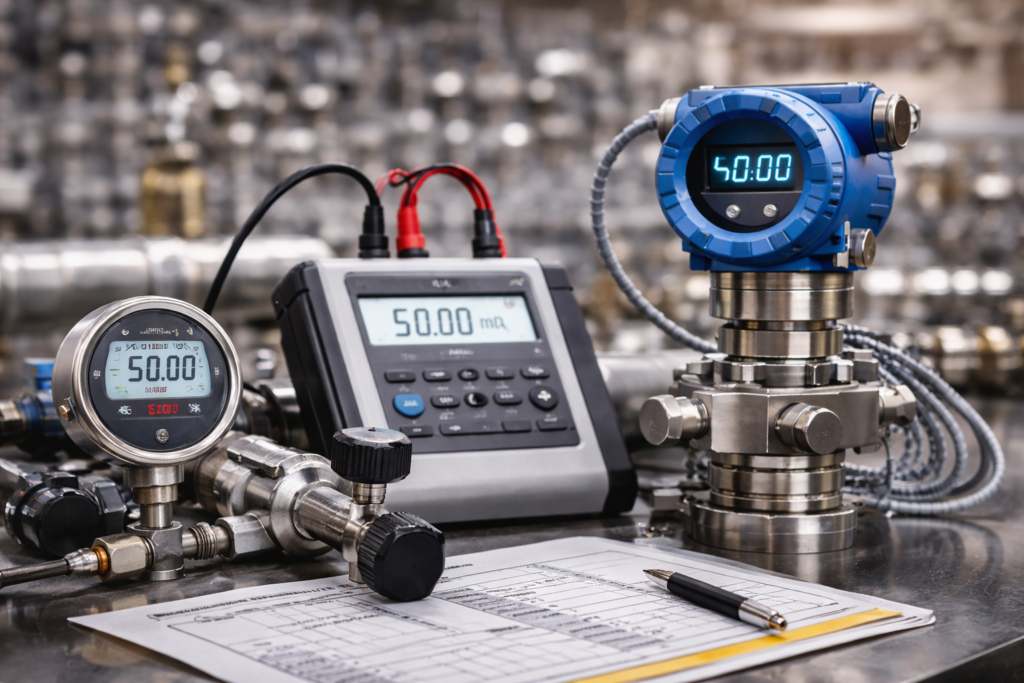
Pressure transmitters play a critical role in process control, alarm management, and Safety Instrumented Systems (SIS). However, even the most advanced transmitter can become unreliable if it is poorly calibrated or its measurement uncertainty is misunderstood.
In safety-critical industries such as oil and gas, offshore FPSOs, petrochemicals, power generation, and chemical processing, improper calibration and ignored uncertainty have contributed to missed alarms, delayed shutdowns, and major incidents.
This HSSETips.com guide explains pressure transmitter calibration and uncertainty in clear, practical terms—helping HSSE professionals, engineers, and technicians ensure trustworthy pressure measurements.
What Is Pressure Transmitter Calibration?
Pressure transmitter calibration is the process of comparing the transmitter’s output signal against a traceable reference standard and adjusting it to ensure the output accurately represents the applied pressure.
Calibration verifies that:
- The transmitter measures pressure correctly
- Output signals are within acceptable tolerance
- The instrument performs as intended in safety and control systems
HSSE principle:
Calibration verifies accuracy—it does not eliminate uncertainty.
Why Calibration Matters in HSSE and Process Safety
Pressure transmitters are commonly used for:
- High-pressure alarms (PAH / PAHH)
- Emergency Shutdown (ESD) activation
- Safety Instrumented Functions (SIFs)
- Overpressure protection logic
- Environmental and emissions monitoring
If a transmitter is miscalibrated:
- Alarms may activate too late—or not at all
- Trips may occur unnecessarily
- Control loops may become unstable
- Safety barriers may silently fail
Types of Pressure Transmitter Calibration
1. Zero Calibration
Ensures the transmitter outputs the correct signal at zero pressure.
Example:
- 0 bar → 4.00 mA
2. Span Calibration
Ensures correct output at full-scale pressure.
Example:
- 100 bar → 20.00 mA
3. Multi-Point Calibration
Verifies accuracy across the entire operating range (e.g., 0%, 25%, 50%, 75%, 100%).
HSSETips.com recommendation:
Always perform multi-point calibration for safety-critical transmitters.
Calibration vs Adjustment (Important Distinction)
| Activity | Purpose |
|---|---|
| Calibration | Verification of performance |
| Adjustment | Correction of deviation |
A transmitter may be:
- Calibrated but out of tolerance
- Adjusted and then recalibrated
All adjustments must be documented and authorized, especially in SIS applications.
What Is Measurement Uncertainty?
Measurement uncertainty is the quantified doubt associated with a measurement result.
It defines the range within which the true pressure value is expected to lie, even after calibration.
Example:
- Measured pressure: 50.0 bar
- Uncertainty: ±0.2 bar
- True pressure range: 49.8–50.2 bar
Sources of Pressure Transmitter Uncertainty
Measurement uncertainty is influenced by multiple factors:
1. Reference Standard Accuracy
Calibration equipment is never perfect.
2. Transmitter Performance
Includes:
- Linearity
- Repeatability
- Hysteresis
3. Environmental Conditions
- Temperature
- Humidity
- Vibration
4. Long-Term Drift
Electronic components drift over time.
5. Calibration Method
- Single-point vs multi-point
- Static vs dynamic calibration
Accuracy vs Uncertainty (Common Confusion)
❌ Accuracy tells you the exact value.
✅ Accuracy defines limits; uncertainty quantifies confidence.
Example:
- Transmitter accuracy: ±0.1% of span
- Measurement uncertainty: ±0.15 bar
Both must be considered in safety decisions.
Calibration Traceability and Standards
All calibration must be:
- Traceable to national or international standards
- Documented with calibration certificates
Common Standards
- ISO/IEC 17025
- IEC 61511 (SIS)
- IEC 61508
- API RP 554
- ISO 9001
Calibration Frequency (HSSE Risk-Based Approach)
Calibration intervals should be based on:
- SIL requirements
- Criticality of the measurement
- Historical drift data
- Environmental severity
Typical Intervals
| Application | Interval |
|---|---|
| SIS transmitters | 6–12 months |
| Control transmitters | 12–24 months |
| Non-critical monitoring | Risk-based |
Pressure Transmitter Calibration in SIS
For Safety Instrumented Systems:
- Calibration is part of proof testing
- Hidden failures must be detected
- Calibration results affect PFDavg calculations
HSSE rule:
Calibration errors in SIS loops directly increase risk.
Best Practices for HSSE-Compliant Calibration
✔ Use calibrated reference equipment
✔ Control ambient conditions
✔ Perform multi-point checks
✔ Document as-found and as-left data
✔ Track drift trends
✔ Include uncertainty statements
✔ Integrate with asset integrity systems
Common HSSE Mistakes to Avoid
❌ Ignoring uncertainty values
❌ Using untraceable calibrators
❌ Skipping intermediate calibration points
❌ Failing to document adjustments
❌ Assuming “calibrated” means “exact”
Practical HSSE Example
Scenario: High-Pressure Alarm Set at 50 bar
- Transmitter uncertainty: ±0.2 bar
- Alarm may trigger between 49.8–50.2 bar
Without accounting for uncertainty:
- Alarm reliability is compromised
- Risk of delayed response increases
Conclusion
Pressure transmitter calibration and uncertainty are fundamental elements of process safety and HSSE performance. Calibration ensures correctness, while uncertainty defines confidence.
For HSSE professionals, understanding both is essential to:
- Reliable alarms and trips
- Effective Safety Instrumented Functions
- Regulatory compliance
- Protection of people, assets, and the environment
Frequently Asked Questions (FAQs)
Does calibration remove uncertainty?
No. Calibration reduces error, but uncertainty always remains.
Why is uncertainty important in safety systems?
It affects alarm setpoints, trip limits, and risk calculations.
How often should safety transmitters be calibrated?
Based on SIL verification and risk assessment—often annually.
Can a transmitter be accurate but unsafe?
Yes. Poor uncertainty management can still cause unsafe outcomes.
Related Topics:
- 👉 Gauge Errors vs Transmitter Accuracy
- 👉 Pressure Gauge Accuracy Classes Explained
- 👉 How to Select Pressure Instruments for Safety-Critical Systems
- 👉 Safety Instrumented Systems (SIS) Explained





Pingback: Pressure Equipment Safety Regulations: A Practical HSSE Guide to Compliance, Risk Control, and Incident Prevention - HSSE Tips
Pingback: Difference Between Pressure Switches and Pressure Transmitters: A Practical HSSE Guide for Safe and Reliable Operations - HSSE Tips