
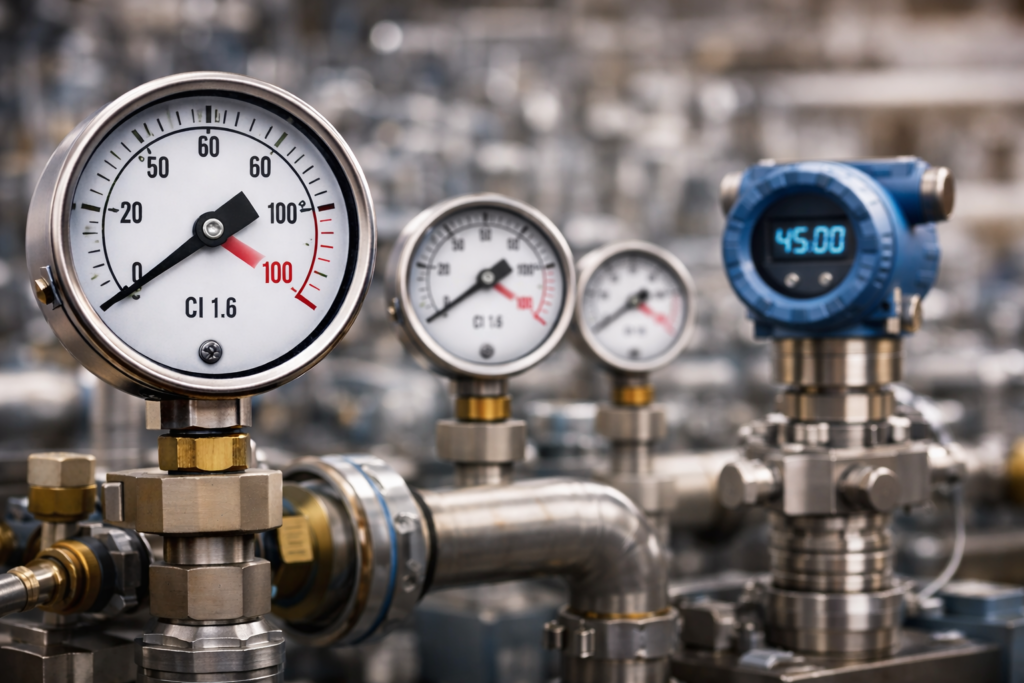
Pressure gauges are among the most common instruments found in industrial facilities. However, their accuracy classes are often misunderstood, leading to incorrect assumptions, unsafe decisions, and missed warning signs.
In HSSE-critical environments such as oil and gas, FPSOs, refineries, power plants, and manufacturing sites, understanding pressure gauge accuracy classes is essential for risk control, maintenance planning, and safe operations.
This guide explains pressure gauge accuracy classes in clear, practical terms—using real-world examples and industry standards relevant to HSSETips.com readers.
What Is a Pressure Gauge Accuracy Class?
A pressure gauge accuracy class defines the maximum permissible error of the gauge, expressed as a percentage of the full-scale (FS) value.
It tells you how far the gauge reading can deviate from the true pressure under reference conditions.
Key Point
Pressure gauge accuracy is based on full scale, not the actual reading.
Common Pressure Gauge Accuracy Classes
The most widely used accuracy classes include:
| Accuracy Class | Maximum Error (± % FS) | Typical Application |
|---|---|---|
| CI 4.0 | ±4.0% | Rough indication |
| CI 2.5 | ±2.5% | General industrial use |
| CI 1.6 | ±1.6% | Process monitoring |
| CI 1.0 | ±1.0% | Safety-critical indication |
| CI 0.6 | ±0.6% | Test and reference gauges |
| CI 0.25 | ±0.25% | Calibration standards |
How to Interpret Accuracy Classes (With Examples)
Example: CI 1.0 Pressure Gauge
- Gauge range: 0–100 bar
- Accuracy class: CI 1.0
- Maximum error: ±1 bar
| Gauge Reading | Actual Pressure Could Be |
|---|---|
| 10 bar | 9–11 bar |
| 50 bar | 49–51 bar |
| 90 bar | 89–91 bar |
⚠️ HSSE insight:
Even at low pressures, the error remains ±1 bar because accuracy is tied to full scale.
Why Full-Scale Accuracy Matters in HSSE
Choosing a gauge with too large a range reduces accuracy at normal operating pressures.
Poor Selection Example
- Operating pressure: 15 bar
- Gauge range: 0–100 bar
- Accuracy class: CI 2.5
➡ Maximum error = ±2.5 bar
➡ Error ≈ 17% of operating pressure
This is unacceptable for:
- Pressure trend monitoring
- Early leak detection
- Barrier integrity checks
Pressure Gauge Accuracy Zones
Many standards divide gauge accuracy across scale segments:
- Outer third of the scale → best accuracy
- Lower third → reduced readability and accuracy
HSSE Best Practice
Normal operating pressure should fall between 30% and 70% of full scale.
Factors That Affect Pressure Gauge Accuracy in Service
Accuracy class applies under laboratory conditions. In real operations, accuracy is affected by:
1. Vibration
- Causes pointer oscillation
- Leads to mechanical wear
- Common near pumps and compressors
2. Temperature
- Thermal expansion alters Bourdon tube response
- High ambient temperatures accelerate drift
3. Pressure Pulsation
- Damages internal components
- Reduces readability
4. Orientation and Installation
- Poor mounting introduces mechanical stress
5. Aging and Wear
- Accuracy degrades over time
- Regular calibration is required
Accuracy Class vs Calibration
Calibration:
- Verifies gauge performance
- Does not improve the original accuracy class
A CI 2.5 gauge cannot become CI 1.0, even after calibration.
Pressure Gauge vs Pressure Transmitter Accuracy
| Feature | Pressure Gauge | Pressure Transmitter |
|---|---|---|
| Accuracy basis | % of full scale | % of span / reading |
| Typical accuracy | ±1.6–2.5% FS | ±0.5–0.05% |
| Drift | High | Low |
| Alarm suitability | No | Yes |
| SIS suitability | No | Yes |
HSSE rule:
Gauges are for indication, transmitters are for control and safety.
Selecting the Right Accuracy Class (HSSE Guidance)
Use CI 2.5 When:
- Only rough indication is needed
- No safety or control decision depends on it
Use CI 1.6 When:
- Monitoring process trends
- Supporting routine inspections
Use CI 1.0 When:
- Operators rely on the reading for decisions
- Overpressure risk exists
- Gauge backs up a transmitter
Use CI 0.6 or Better When:
- Calibration or testing is required
- Gauge is a reference instrument
Applicable Standards and References
Pressure gauge accuracy classes are defined in:
- EN 837-1 / EN 837-3
- ASME B40.100
- ISO 5171 (test gauges)
HSSETips.com recommends compliance with applicable national and international standards.
Common HSSE Misconceptions
❌ “The gauge reading is accurate at all points.”
✅ Accuracy varies and is tied to full scale.
❌ “Calibration makes a gauge more accurate.”
✅ Calibration only verifies performance.
❌ “Any gauge can be used for alarms.”
✅ Gauges must never be used for alarms or trips.
HSSE Best Practices Summary
- Always check the accuracy class before installing a gauge
- Avoid oversized ranges
- Keep operating pressure within mid-scale
- Protect gauges from vibration and pulsation
- Never rely on gauges for safety-critical functions
Conclusion
Pressure gauge accuracy classes are a fundamental but often overlooked aspect of process safety. Misunderstanding them can lead to false confidence, delayed response, and serious incidents.
For HSSE professionals, selecting the correct accuracy class—and understanding its limitations—is essential to protecting people, assets, and the environment.
Frequently Asked Questions (FAQs)
What does CI 1.6 mean on a pressure gauge?
It means the gauge can deviate by ±1.6% of its full-scale range.
Are pressure gauges accurate enough for alarms?
No. Only pressure transmitters should be used for alarms and trips.
Why are gauges inaccurate at low readings?
Because error is based on full scale, not the actual reading.
How often should pressure gauges be calibrated?
Based on risk, service conditions, and company procedures—typically annually.
Related Topics:
- 👉 Gauge Errors vs Transmitter Accuracy
- 👉 Process Safety and Barrier Management
- 👉 Overpressure Protection Systems Explained
- 👉 Permit to Work (PTW) Systems