
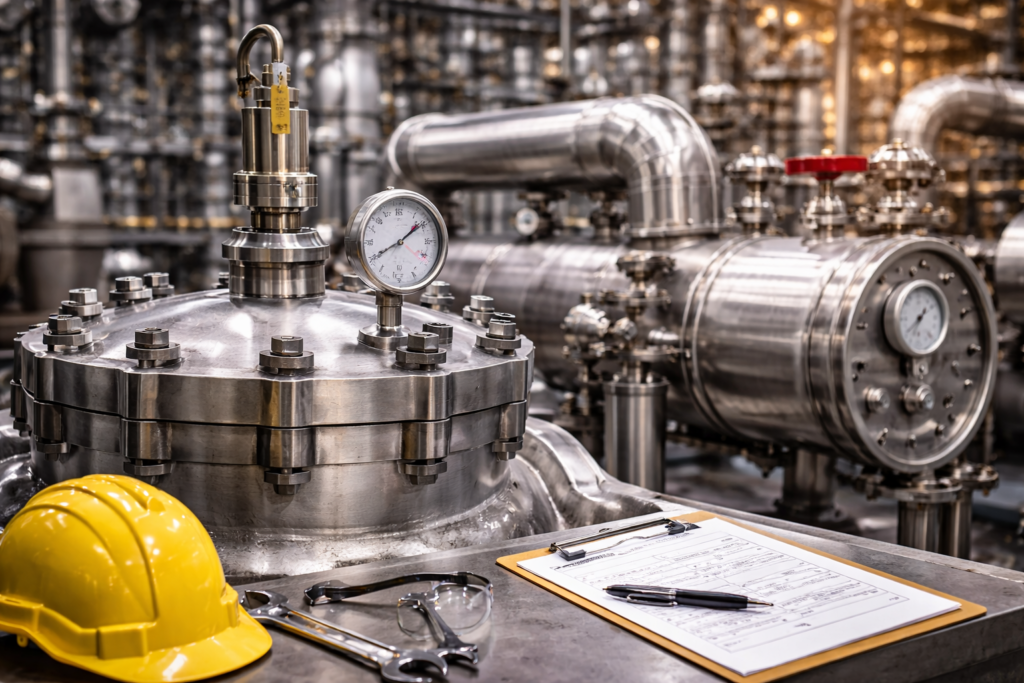
Pressure equipment is used extensively across industrial operations—from boilers, pressure vessels, and pipelines to compressors, separators, and storage tanks. When not properly designed, installed, operated, and maintained, pressure equipment can fail catastrophically, leading to explosions, fires, toxic releases, fatalities, and environmental damage.
For HSSE professionals, understanding pressure equipment safety regulations is essential for ensuring legal compliance, process safety, and asset integrity.
This HSSETips.com guide explains the key pressure equipment safety regulations, regulatory frameworks, responsibilities, and best practices applicable to oil & gas, offshore FPSOs, power plants, chemical facilities, and manufacturing sites.
What Is Pressure Equipment?
Pressure equipment refers to any vessel, piping, or accessory designed to contain fluids under pressure above atmospheric levels.
Common Examples
- Pressure vessels
- Boilers and steam drums
- Heat exchangers
- Pipelines and piping systems
- Compressors and receivers
- Safety relief valves and rupture discs
Why Pressure Equipment Is a Major HSSE Risk
Pressure-related failures are often:
- Sudden and violent
- High-energy events
- Difficult to mitigate once initiated
Typical Consequences
- Vessel rupture
- Jet fires and explosions
- Toxic or flammable releases
- Structural damage
- Fatal injuries
HSSE principle:
Pressure containment is a primary safety barrier—its failure is often catastrophic.
Core Objectives of Pressure Equipment Safety Regulations
Pressure equipment regulations are designed to ensure that equipment is:
- Properly designed and manufactured
- Tested and certified before use
- Installed and operated safely
- Inspected and maintained throughout its lifecycle
- Decommissioned safely
Major International Pressure Equipment Regulations and Standards
1. Pressure Equipment Directive (PED) – Europe
Directive: 2014/68/EU
Applies to pressure equipment with:
- Maximum allowable pressure > 0.5 bar
Key requirements:
- Equipment categorization (I–IV)
- CE marking
- Conformity assessment
- Approved materials and design
2. ASME Boiler and Pressure Vessel Code (BPVC)
Widely used globally, especially in oil & gas and power sectors.
Key sections include:
- Section I – Power boilers
- Section VIII – Pressure vessels
- Section IX – Welding qualifications
3. API Standards (Oil & Gas)
Commonly applied offshore and onshore:
- API 510 – Pressure vessel inspection
- API 570 – Piping inspection
- API 653 – Storage tank inspection
- API RP 521 – Pressure relief systems
4. UK Pressure Systems Safety Regulations (PSSR)
Applies to pressure systems used at work.
Key requirements:
- Written Scheme of Examination (WSE)
- Competent person inspection
- Defined operating limits
5. OSHA & National Regulations
Many countries adopt pressure safety rules under:
- Occupational Safety and Health regulations
- Factories Acts
- Environmental protection laws
Pressure Equipment Lifecycle Compliance (HSSE Perspective)
1. Design and Fabrication
- Approved codes and standards
- Qualified materials
- Design pressure and temperature defined
- Hazard analysis conducted
2. Installation and Commissioning
- Proper mounting and supports
- Pressure testing (hydrostatic or pneumatic)
- Certification before operation
3. Operation
- Defined safe operating limits
- Trained personnel
- Operating procedures in place
4. Inspection and Maintenance
- Risk-based inspection (RBI)
- Periodic testing
- Corrosion and fatigue monitoring
5. Decommissioning
- Safe depressurization
- Removal of residual energy
- Environmental protection
Pressure Relief and Overpressure Protection
All pressure equipment must be protected against overpressure.
Common Protection Devices
- Safety relief valves (SRVs)
- Pressure safety valves (PSVs)
- Rupture discs
HSSE rule:
No pressure system should rely solely on operational controls for overpressure protection.
Roles and Responsibilities Under Pressure Equipment Regulations
Duty Holders
- Ensure compliance with regulations
- Provide resources for inspection and maintenance
Engineers
- Design and specify compliant equipment
- Select appropriate protection systems
HSSE Professionals
- Ensure regulatory compliance
- Conduct audits and risk assessments
- Monitor inspection regimes
Operators
- Operate within defined limits
- Report abnormal conditions
Common HSSE Failures Related to Pressure Equipment
❌ Operating beyond design pressure
❌ Blocked or isolated relief devices
❌ Deferred inspections
❌ Unauthorized modifications
❌ Poor documentation
Many major industrial accidents have involved pressure equipment failures that were previously known but not addressed.
Pressure Equipment and Process Safety Management
Pressure equipment safety is a key element of:
- Process Hazard Analysis (PHA)
- Mechanical Integrity programs
- Management of Change (MOC)
- Permit to Work (PTW) systems
Best Practices for HSSE Compliance
✔ Maintain pressure equipment registers
✔ Clearly label design limits
✔ Implement risk-based inspection
✔ Ensure relief devices are tested
✔ Control modifications through MOC
✔ Train operators and technicians
✔ Maintain inspection and certification records
Practical HSSE Example
Scenario: Pressure Vessel Without Valid Inspection
- Vessel operating normally
- Inspection overdue
- Corrosion undetected
Outcome:
- Wall thinning progresses
- Sudden rupture occurs
- Major incident results
Lesson:
Regulatory compliance is not paperwork—it is risk control.
Conclusion
Pressure equipment safety regulations exist to prevent some of the most severe industrial accidents imaginable. Compliance is not optional—it is a legal, moral, and professional obligation.
For HSSE professionals, pressure equipment safety must be managed proactively throughout the entire lifecycle, from design to decommissioning.
Strong pressure equipment management protects people, assets, and the environment.
Frequently Asked Questions (FAQs)
What pressure equipment is regulated?
Any equipment designed to contain fluids under pressure above defined limits.
Are pressure gauges considered pressure equipment?
They are accessories but still subject to inspection and maintenance requirements.
How often should pressure equipment be inspected?
Based on regulations, risk assessment, and applicable standards.
Who is responsible for compliance?
The duty holder or employer operating the pressure system.
Related Topics:
- 👉 How to Select Pressure Instruments for Safety-Critical Systems
- 👉 Pressure Transmitter Calibration and Uncertainty
- 👉 Pressure Gauge Accuracy Classes Explained
- 👉 Permit to Work (PTW) Systems Explained





Pingback: Safety Instrumented Systems (SIS) Explained: A Practical HSSE Guide to Functional Safety and Major Accident Prevention - HSSE Tips
Pingback: Gauge Errors vs Transmitter Accuracy: A Practical HSSE Guide for Safer Operations - HSSE Tips