
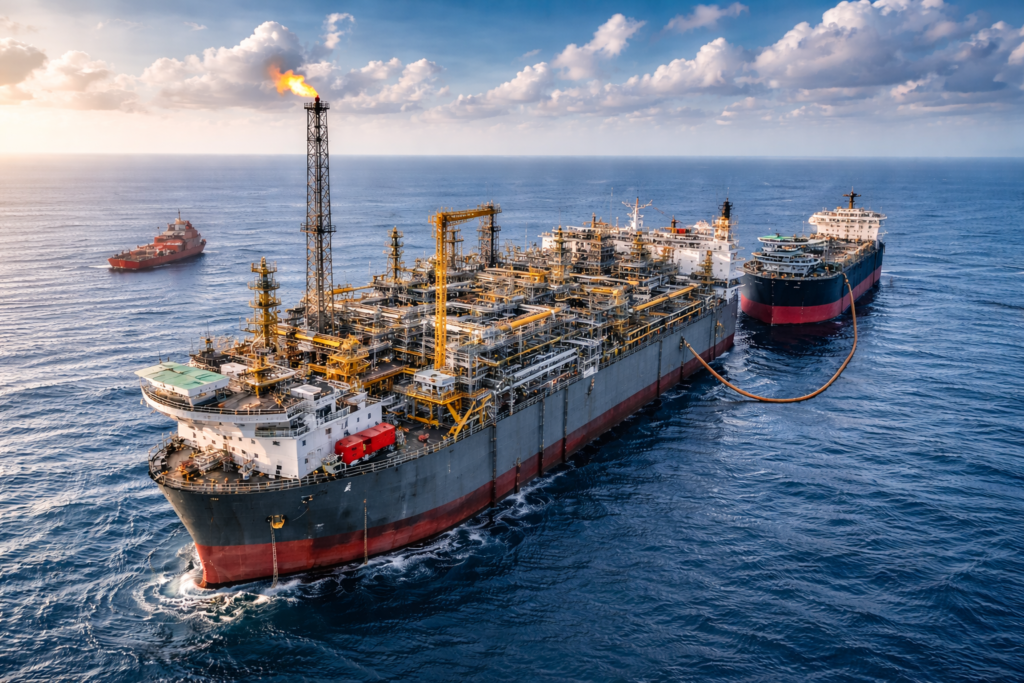
FPSO Operations: The Complete Guide
Floating Production Storage and Offloading (FPSO) vessels are complex offshore facilities designed to receive hydrocarbons from subsea wells, process oil and gas, store crude oil, and safely offload it to export tankers. An FPSO integrates production, marine, utility, maintenance, safety, and accommodation systems into a single operating asset.
This page serves as a comprehensive FPSO operations hub, covering all activities carried out onboard an FPSO, with direct links to detailed articles, procedures, safety guides, and training resources related to offshore operations.
FPSO Overview and Fundamentals
FPSOs are designed to operate continuously in harsh offshore environments while maintaining safe, efficient, and compliant production.
Key topics covered under this section include:
- What an FPSO is and how it works
- Differences between FPSO, FSO, TLP, and semi-submersible facilities
- Typical FPSO layout and zoning
- FPSO life cycle from design to decommissioning
- FPSO organizational structure and onboard roles
Production Operations and Process Systems
Production operations form the core function of an FPSO, ensuring hydrocarbons are safely processed to export specifications.
Major production activities include:
- Well fluid reception and production manifolds
- First, second, and third stage separation
- Crude oil stabilization and storage
- Gas compression and gas export systems
- Produced water treatment and discharge
- Metering and custody transfer systems
Marine Operations and Crude Offloading
Marine operations ensure the FPSO maintains position and safely transfers crude oil to shuttle tankers.
This section covers:
- Mooring systems (internal and external turret systems)
- Station keeping and heading control
- Tandem and side-by-side offloading operations
- Hose handling and cargo transfer procedures
- Marine communications and navigation safety
- SIMOPS during offloading activities
Utility and Support Systems
Utility systems provide essential services that support production, safety, and habitability onboard the FPSO.
Typical FPSO utility systems include:
- Power generation and electrical distribution
- Instrument air and utility air systems
- Fuel gas and diesel supply systems
- Fresh water generation (RO and evaporators)
- Sewage treatment and waste water systems
Maintenance and Asset Integrity Management
Maintenance and asset integrity activities ensure equipment reliability, regulatory compliance, and safe operation throughout the FPSO life cycle.
Key maintenance activities include:
- Planned preventive maintenance (PPM)
- Corrective and breakdown maintenance
- Rotating and static equipment maintenance
- Corrosion control and inspection programs
- Structural integrity monitoring and repairs
Health, Safety, Security, and Environment (HSSE)
HSSE management is fundamental to FPSO operations due to the presence of major accident hazards.
This section addresses:
- HSSE leadership and safety culture
- Permit to Work (PTW) systems
- Job Hazard Analysis (JHA) and risk assessments
- Toolbox talks and safety communication
- Life-saving rules and behavioral safety programs
Emergency Response and Crisis Management
FPSOs maintain robust emergency response systems to protect personnel, assets, and the environment.
Emergency scenarios covered include:
- Fire and explosion response
- Gas release and toxic exposure
- Man overboard incidents
- Vessel collision and offloading emergencies
- Helicopter ditching and aviation incidents
- Medical emergencies and evacuation
Simultaneous Operations (SIMOPS)
SIMOPS occur when multiple activities are performed at the same time, increasing operational risk.
Common FPSO SIMOPS include:
- Production during crude offloading
- Lifting operations near live process areas
- Hot work during maintenance campaigns
- Marine operations alongside deck activities
Lifting, Rigging, and Deck Operations
Deck operations are among the highest-risk activities onboard an FPSO and require strict controls.
This section includes:
- Offshore crane operations
- Lifting gear inspection and certification
- Deck cargo handling and storage
- Container management and securing
- Dropped object prevention measures
Process Safety and Major Accident Hazard Control
Process safety focuses on preventing catastrophic incidents involving hydrocarbons and energy release.
Key process safety topics include:
- Process Safety Management (PSM)
- Hazard identification and risk studies (HAZID/HAZOP)
- Bow-tie and barrier management
- Safety-critical elements and performance standards
Environmental Management and Regulatory Compliance
FPSOs operate under strict environmental regulations to protect the marine environment.
Environmental management activities include:
- Produced water discharge control
- Flaring and emissions management
- Chemical storage and usage control
- Waste segregation and disposal
- Oil spill prevention and response planning
Accommodation, Welfare, and Human Factors
Crew welfare directly impacts safety and operational performance onboard FPSOs.
Topics covered include:
- Living quarters safety and comfort
- Fatigue management and shift work
- Food safety and hygiene offshore
- Mental health and wellbeing
- Human factors and ergonomics
Training, Competency, and Offshore Careers
Competent personnel are essential for safe FPSO operations.
This section focuses on:
- Offshore induction and onboarding
- Competency assurance systems
- Role-based training and certification
- FPSO career pathways and progression
Control Room and Digital Systems
Modern FPSOs rely heavily on automation and digital monitoring systems.
Key systems include:
- Distributed Control Systems (DCS)
- Emergency Shutdown (ESD) systems
- Fire and Gas detection systems
- Condition monitoring and alarms
FPSO Life Extension and Decommissioning
FPSO operations include planning for asset longevity and end-of-life activities.
This section covers:
- FPSO life extension strategies
- Brownfield modifications
- Decommissioning planning and execution
Explore FPSO Safety Resources and Training Materials
Discover practical offshore safety resources, including:
- FPSO safety posters and infographics
- Permit-to-Work awareness materials
- Lifting and dropped object prevention guides
- Emergency response training resources