
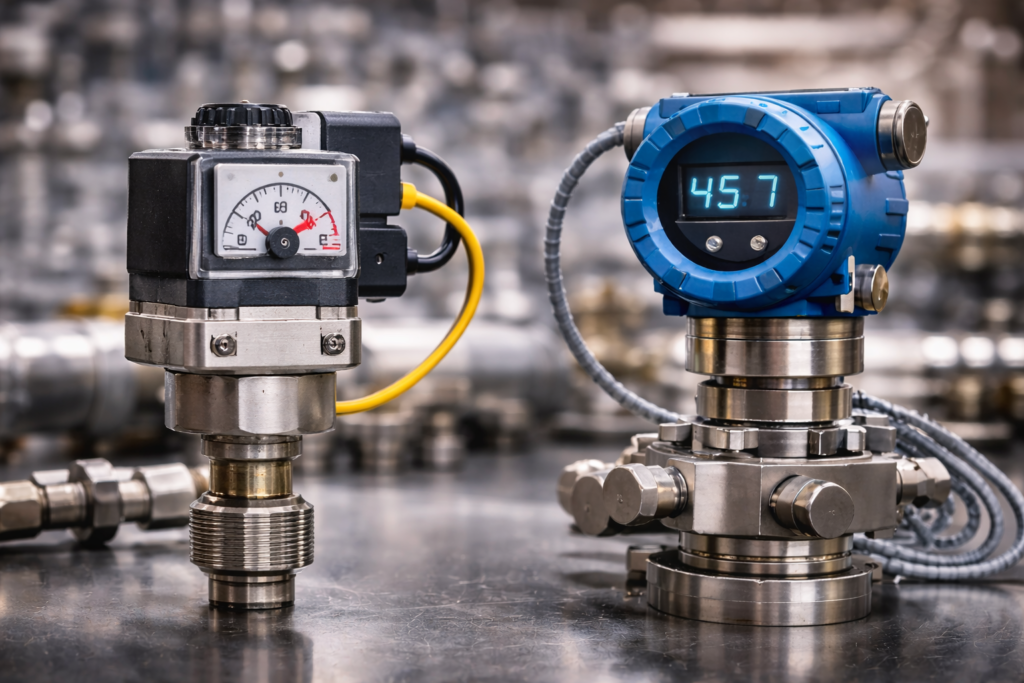
Pressure measurement plays a vital role in process control, alarm activation, and safety protection systems. Two commonly used instruments—pressure switches and pressure transmitters—are often confused or incorrectly treated as interchangeable.
In safety-critical industries such as oil and gas, offshore FPSOs, petrochemicals, power plants, and manufacturing, misunderstanding the difference between pressure switches and transmitters can result in nuisance trips, missed alarms, or catastrophic failures.
This HSSETips.com guide explains the key differences, applications, limitations, and HSSE best practices for pressure switches and pressure transmitters.
What Is a Pressure Switch?
A pressure switch is a mechanical or electromechanical device that opens or closes an electrical contact when pressure reaches a preset value.
It provides a binary (ON/OFF) signal.
Typical Outputs
- Open / Closed contact
- NO / NC (Normally Open / Normally Closed)
Common Uses
- Simple alarms
- Pump start/stop control
- Low-risk interlocks
- Utility systems
Key Characteristics of Pressure Switches
- Fixed or adjustable setpoint
- Mechanical sensing element
- No continuous pressure indication
- Limited accuracy
- Susceptible to drift and vibration
⚠️ Important HSSE Note:
Pressure switches do not measure pressure continuously—they only respond at a specific point.
What Is a Pressure Transmitter?
A pressure transmitter is an electronic instrument that continuously measures pressure and converts it into a proportional electrical signal.
Typical Outputs
- 4–20 mA
- HART
- Modbus
- Foundation Fieldbus
Transmitters provide real-time pressure data to control and safety systems.
Key Characteristics of Pressure Transmitters
- Continuous measurement
- High accuracy and repeatability
- Temperature compensation
- Diagnostic capability
- Suitable for automation and safety systems
HSSETips.com recommendation:
Pressure transmitters are the preferred choice for control and safety-critical applications.
Pressure Switch vs Pressure Transmitter: Core Differences
| Feature | Pressure Switch | Pressure Transmitter |
|---|---|---|
| Output | ON / OFF | Continuous signal |
| Measurement type | Discrete | Analog / digital |
| Accuracy | Low | High |
| Drift over time | High | Low |
| Alarm quality | Poor | Excellent |
| Control loop use | ❌ No | ✅ Yes |
| Trending & logging | ❌ No | ✅ Yes |
| SIL suitability | ❌ Generally No | ✅ Yes (certified) |
Accuracy and Reliability Considerations
Pressure Switches
- Accuracy affected by:
- Mechanical wear
- Setpoint hysteresis
- Temperature
- Vibration
- Require frequent functional testing
Pressure Transmitters
- Accuracy specified as % of span or reading
- Stable over long periods
- Compensated for environmental effects
Alarm and Safety Performance
Pressure Switch Limitations
- Single setpoint only
- No early warning
- High risk of nuisance trips
- No alarm prioritization
Pressure Transmitter Advantages
- Multiple alarm levels (PA, PAH, PAHH)
- Early warning before limits
- Integrated with alarm management systems
- Better operator response time
HSSE principle:
Good alarms prevent incidents—poor alarms create them.
Use in Safety Instrumented Systems (SIS)
Pressure Switches
❌ Rarely SIL-certified
❌ Limited diagnostics
❌ Difficult proof testing
Pressure Transmitters
✅ SIL-certified models available
✅ Diagnostic coverage
✅ Suitable for 1oo2 / 2oo3 architectures
HSSE rule:
Pressure switches should never be the primary sensing element in a Safety Instrumented Function.
Typical Applications Comparison
Where Pressure Switches Are Acceptable
- Low-risk utilities
- Non-critical pump protection
- HVAC systems
- Simple machinery
Where Pressure Transmitters Are Required
- Overpressure protection
- ESD systems
- Process control
- Fire and gas integration
- Environmental compliance
Common HSSE Mistakes to Avoid
❌ Using pressure switches for safety alarms
❌ Relying on switches for trip logic
❌ Ignoring switch hysteresis
❌ Oversimplifying high-risk systems
❌ Treating switches as transmitters
Practical HSSE Example
High-Pressure Protection Scenario
- Operating pressure: 45 bar
- Trip limit: 50 bar
Using a Pressure Switch
- Trips only at exact setpoint
- No early warning
- Risk of delayed shutdown
Using a Pressure Transmitter
- High alarm at 47 bar
- High-high trip at 50 bar
- Time for operator intervention
Selection Guidance for HSSE Professionals
| Requirement | Recommended Instrument |
|---|---|
| Process control | Pressure transmitter |
| Alarm management | Pressure transmitter |
| SIS application | Pressure transmitter |
| Simple machine protection | Pressure switch |
| Trending & diagnostics | Pressure transmitter |
Applicable Standards and Guidance
- IEC 61508 / IEC 61511
- ISA-18.2 / EEMUA 191
- API RP 14C
- API RP 554
- ISO 10418
Conclusion
Pressure switches and pressure transmitters serve very different purposes. While pressure switches may be suitable for simple, low-risk applications, pressure transmitters are essential for safe, accurate, and reliable pressure monitoring in modern industrial systems.
For HSSE professionals, understanding this difference is critical to:
- Preventing overpressure incidents
- Improving alarm quality
- Strengthening safety barriers
- Protecting lives, assets, and the environment
Frequently Asked Questions (FAQs)
Can a pressure switch replace a pressure transmitter?
No. Pressure switches do not provide continuous measurement or sufficient reliability for safety systems.
Are pressure switches accurate?
They are relatively inaccurate and prone to drift compared to transmitters.
Why are transmitters preferred for alarms?
They provide continuous data, early warning, and better alarm management.
Can pressure switches be used in SIS?
Only in very limited cases and rarely recommended.
Related Topics:
- 👉 Gauge Errors vs Transmitter Accuracy
- 👉 Pressure Gauge Accuracy Classes Explained
- 👉 Pressure Transmitter Calibration and Uncertainty
- 👉 How to Select Pressure Instruments for Safety-Critical Systems