
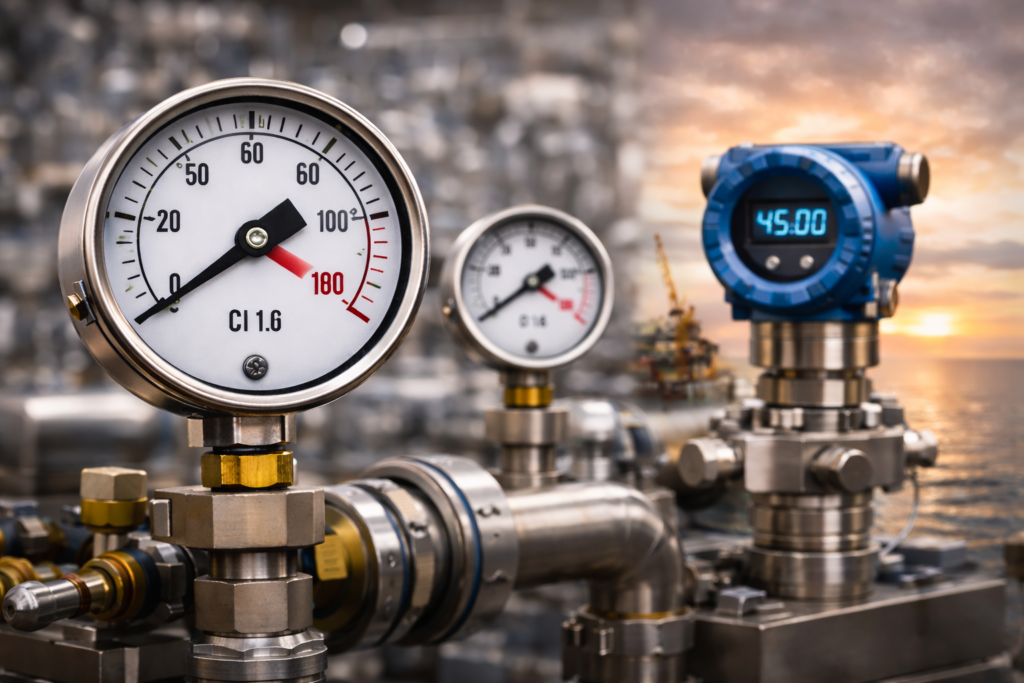
Selecting the right pressure instrument for a safety-critical system is not just an engineering decision—it is a life-saving barrier. In industries such as oil and gas, offshore FPSOs, petrochemicals, power generation, and chemical processing, incorrect pressure measurement has been a direct contributor to major accidents, loss of containment, fires, explosions, and environmental damage.
This HSSETips.com guide explains how to correctly select pressure instruments for safety-critical systems, aligning with process safety principles, functional safety standards, and HSSE best practices.
What Is a Safety-Critical Pressure Instrument?
A pressure instrument is considered safety-critical when its failure could result in:
- Overpressure or vessel rupture
- Loss of containment
- Fire or explosion
- Environmental release
- Serious injury or fatality
Examples include pressure measurements used for:
- High-pressure alarms (PAH / PAHH)
- Emergency Shutdown (ESD) systems
- Safety Instrumented Systems (SIS)
- Overpressure protection logic
- Burner management systems
Why Instrument Selection Matters in HSSE
Many incidents are traced back to:
- Incorrect instrument type selection
- Inadequate accuracy
- Poor reliability in harsh conditions
- Misuse of gauges instead of transmitters
- Lack of redundancy
HSSE principle:
A safety system is only as strong as its weakest instrument.
Step 1: Identify the Safety Function
Before selecting any pressure instrument, clearly define:
- What safety action does this pressure measurement initiate?
- What happens if it fails?
- What is the required response time?
Examples
| Safety Function | Instrument Requirement |
|---|---|
| High-pressure alarm | High accuracy, fast response |
| ESD activation | Certified SIS transmitter |
| Overpressure prevention | Redundant transmitters |
| Firewater system monitoring | High reliability |
Step 2: Determine SIL Requirements
Safety-critical pressure instruments must meet IEC 61508 / IEC 61511 requirements.
Key SIL Parameters
- Safety Integrity Level (SIL 1–4)
- Probability of Failure on Demand (PFDavg)
- Diagnostic coverage
- Proof test interval
HSSE Rule
Pressure gauges are NOT SIL-rated instruments.
Only certified pressure transmitters may be used in SIS loops.
Step 3: Choose the Correct Instrument Type
Pressure Gauges
❌ Not acceptable for safety-critical functions
❌ No remote signal
❌ No diagnostics
❌ Not SIL compliant
Pressure Switches
⚠ Limited use
⚠ Susceptible to drift
⚠ Require frequent testing
Pressure Transmitters
✅ Suitable for safety-critical systems
✅ Continuous signal
✅ High accuracy
✅ Diagnostics and redundancy
HSSETips.com recommendation:
Always use pressure transmitters for safety-critical pressure measurement.
Step 4: Select the Right Accuracy and Range
Accuracy Requirements
- Safety systems typically require ±0.1% or better
- Accuracy should be expressed as % of span or reading
Range Selection Rule
Normal operating pressure should fall between 30–70% of full scale
Avoid oversized ranges—they reduce accuracy at operating conditions.
Step 5: Consider Environmental and Process Conditions
Safety-critical instruments must operate reliably under worst-case conditions.
Environmental Factors
- High temperature
- Vibration
- Corrosive atmosphere
- Offshore salt spray
- Humidity and flooding
Process Factors
- Pressure pulsation
- Rapid transients
- Fouling or plugging
- Hazardous fluids
Choose:
- Stainless steel or Monel wetted parts
- Remote seals if required
- IP66/IP67 or higher
- ATEX / IECEx certification
Step 6: Redundancy and Voting Logic
Safety-critical pressure systems often require redundancy:
Common Architectures
- 1oo2 (One out of Two)
- 2oo3 (Two out of Three)
Redundancy improves:
- Fault tolerance
- Availability
- Diagnostic coverage
HSSE best practice:
Use independent transmitters with separate impulse lines.
Step 7: Alarm Management and Response Time
Pressure instruments must support:
- Fast response time
- Stable signal (no chatter)
- Clear alarm setpoints
Align with:
- ISA-18.2
- EEMUA 191
Avoid nuisance alarms—poor alarm quality is a known accident precursor.
Step 8: Calibration, Proof Testing, and Lifecycle Management
Calibration
- Establish calibration intervals based on risk
- Use traceable standards
Proof Testing
- Required for SIL compliance
- Detect hidden failures
Lifecycle Management
- Document installation
- Track drift and failures
- Replace aging instruments proactively
Pressure Instrument Selection Checklist (HSSE)
✔ Is the instrument required for a safety function?
✔ Is it SIL-certified?
✔ Is accuracy sufficient at operating pressure?
✔ Is the range correctly selected?
✔ Is it suitable for the environment?
✔ Is redundancy required?
✔ Are alarms clearly defined?
✔ Is proof testing planned?
Common HSSE Mistakes to Avoid
❌ Using pressure gauges for alarms
❌ Oversizing instrument ranges
❌ Ignoring environmental conditions
❌ Single transmitter for high-risk systems
❌ Infrequent proof testing
Applicable Standards and Guidance
- IEC 61508 / IEC 61511
- API RP 521 (Overpressure Protection)
- API RP 14C (Offshore Safety Systems)
- ISO 10418
- ISA-18.2 / EEMUA 191
Conclusion
Selecting pressure instruments for safety-critical systems requires a structured, risk-based approach. The wrong choice can silently defeat critical safety barriers, while the right selection can prevent catastrophic events.
For HSSE professionals, pressure transmitters are not just instruments—they are guardians of life, assets, and the environment.
Frequently Asked Questions (FAQs)
Can pressure gauges be used in safety systems?
No. Pressure gauges must never be used for alarms, trips, or SIS functions.
What accuracy is required for safety-critical pressure measurement?
Typically ±0.1% or better, depending on SIL requirements.
Why is redundancy important?
It improves reliability and fault tolerance, reducing the risk of dangerous failure.
How often should safety-critical pressure instruments be tested?
As defined by SIL verification and risk assessment—often annually or more frequently.
Related Topics:
- 👉 Pressure Gauge Accuracy Classes Explained
- 👉 Gauge Errors vs Transmitter Accuracy
- 👉 Safety Instrumented Systems (SIS) Explained
- 👉 Process Safety and Barrier Management





Pingback: Process Safety and Barrier Management: A Practical HSSE Guide to Preventing Major Accidents - HSSE Tips
Pingback: Pressure Transmitter Calibration and Uncertainty: A Practical HSSE Guide to Accuracy, Reliability, and Process Safety - HSSE Tips